

AS568 O-ring Sizing Chart
Whatever your O-ring sizing requirements may be, Canyon Components can support you! Our AS568 O-ring size chart helps you compare standard O-ring sizes and identify the dimensions you need. If you can't find the O-ring size you need, or if you require something custom, feel free to get in touch with our engineers.
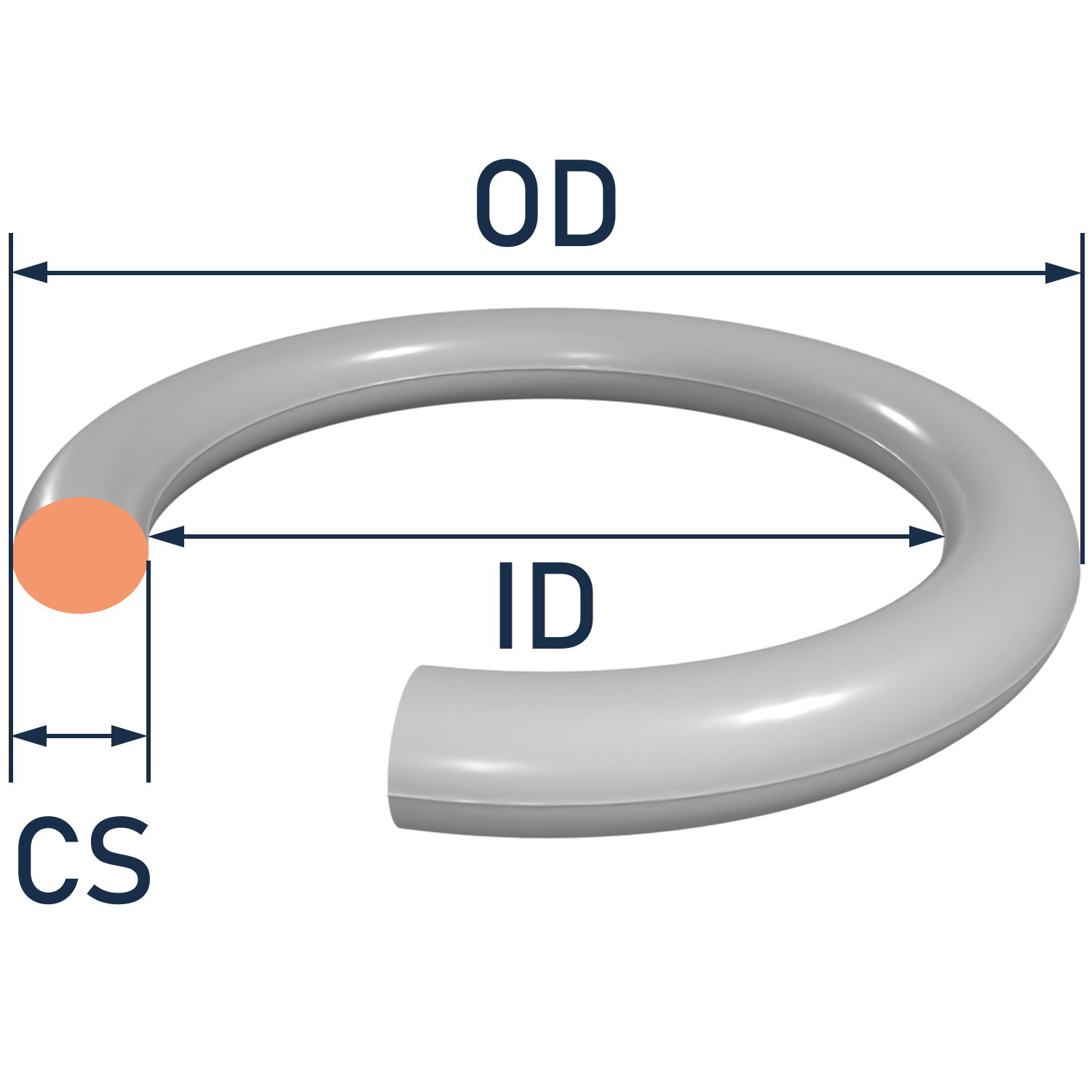
AS568 is one of the most common O-ring sizing standards. The purpose of the table below is to define O-ring size identification codes (dash numbers), O-ring cross sections (CS), O-ring inside diameters (ID), and O-ring outside diameters* (OD) for all AS568 O-ring sizes.
Use this O-ring dimensions chart to look up a known dash number or compare your required dimensions with standard sizes. Whether you are identifying a replacement seal or reviewing O-ring size specifications for a new application, this O-ring size guide provides a starting point for selecting the appropriate size. Final selection should also account for the groove dimensions, material, and operating conditions.
Please note that the O-ring outside diameter is typically used as a reference dimension and is not used to define the dimensional compliance of a standard AS568 O-ring. Inside diameter and cross section, together with their applicable tolerances, are the controlling sizing dimensions.
USA AS568 O-rings from Canyon Components in standard and custom sizes, available in Kalrez®, Canrez®, Chemraz®, and Parker® O-ring materials for critical sealing.
Back to Reference Hub


An AS568 O-ring sizing chart is a standardized reference used to identify the dimensions of O-rings, rubber seals, and gasket components commonly used in industrial sealing applications. The AS568 standard defines a series of dash numbers, each representing a specific combination of O-ring inside diameter (ID) and cross section (CS). These dimensions allow engineers, maintenance teams, and purchasing departments to specify the correct O-ring size for sealing systems used in pumps, valves, hydraulic systems, pneumatic equipment, and mechanical assemblies.
The AS568 standard has become one of the most widely adopted O-ring sizing standards in North America and is used extensively across industries such as aerospace, automotive, oil and gas, semiconductor manufacturing, and food processing. By referencing an AS568 dash number, engineers can ensure that replacement O-rings, rubber seals, and gasket components match the intended groove dimensions and sealing requirements. This standardization simplifies maintenance and ensures compatibility between equipment manufacturers and replacement parts suppliers.
Using a reliable AS568 O-ring sizing chart also helps reduce errors when ordering replacement sealing components. Instead of manually measuring rubber O-rings or guessing dimensions, engineers can reference the chart to identify the exact inside diameter, cross section, and approximate outside diameter associated with a specific dash number. This ensures consistent sealing performance and helps avoid leaks, compression set issues, or premature seal failure.
In an AS568 O-ring sizing chart, dash numbers are identification codes used to define specific O-ring sizes. Each dash number corresponds to a unique combination of inside diameter (ID) and cross section (CS) dimensions for rubber O-rings and sealing gaskets. These dash numbers typically appear in the format -001, -112, -214, or -325, and they are widely recognized across industrial sealing applications.
The dash number system makes it easy to specify and communicate O-ring sizes without needing to list detailed dimensional measurements each time. When an engineer specifies an AS568 dash number, the corresponding O-ring dimensions are already defined by the standard. This ensures consistent manufacturing tolerances and allows suppliers to produce compatible rubber O-rings, elastomer seals, and gasket components for the same size designation.
Dash numbers are grouped into ranges based on cross section size families, meaning that several dash numbers may share the same cross section while having different inside diameters. This structured system simplifies groove design and sealing calculations, making it easier for engineers to design reliable sealing systems using standard O-ring and gasket dimensions.
An AS568 O-ring sizing chart typically includes several critical dimensions used to identify standard O-ring sizes. The most important measurements are the O-ring inside diameter (ID) and the O-ring cross section (CS). These two values define the physical geometry of the rubber O-ring and determine how it will compress inside a sealing groove.
The inside diameter (ID) represents the measurement across the interior of the O-ring, while the cross section (CS) refers to the thickness of the O-ring material itself. Together, these two measurements determine how the O-ring fits into a gland or groove and how much compression occurs when the seal is installed. Proper compression is essential for maintaining reliable sealing performance in applications involving fluids, gases, or vacuum systems.
Many AS568 O-ring charts also include the outside diameter (OD) as a reference dimension. However, the OD is not the defining specification used to determine compliance with the AS568 standard. Instead, it is calculated from the inside diameter and cross section. While the OD can be useful for visual identification or rough comparison, engineers should always rely on ID and CS measurements when selecting rubber O-rings and gasket seals.
In the AS568 O-ring standard, compliance is defined by the inside diameter and cross section dimensions, not by the outside diameter. This design approach ensures that O-rings will properly fit standardized groove dimensions and maintain the correct compression needed for effective sealing.
The outside diameter (OD) of an O-ring is derived mathematically by adding twice the cross section to the inside diameter. Because OD is calculated rather than directly specified, it may vary slightly depending on manufacturing tolerances or measurement methods. For this reason, OD is typically included in an O-ring sizing chart only as a reference dimension.
When selecting rubber O-rings, elastomer seals, or gasket components, engineers should always verify the AS568 dash number, inside diameter, and cross section to ensure compatibility with the groove design. Relying solely on outside diameter can lead to incorrect seal selection, resulting in improper compression, leakage, or premature seal failure.
AS568 sizing standards apply to O-rings and gaskets manufactured from a wide range of elastomer materials. The sizing chart defines the physical dimensions of the seal, but the material itself is selected based on the application environment, chemical exposure, temperature range, and pressure conditions.
Common elastomer materials used with AS568 O-ring sizes include Nitrile (Buna-N), EPDM, FKM (Viton), Silicone, Fluorosilicone, HNBR, and high performance FFKM perfluoroelastomers. Each material provides different performance characteristics. For example, Nitrile rubber offers excellent oil resistance, EPDM provides strong resistance to water and steam, and FKM materials are commonly used for high temperature and chemical resistant sealing applications.
Selecting the correct rubber compound and O-ring material is just as important as choosing the correct AS568 size. Factors such as chemical compatibility, compression set resistance, temperature limits, and regulatory requirements may influence the final material choice. Engineers often reference material datasheets, TDS documents, and test reports to confirm that a particular rubber O-ring or gasket will perform reliably in the intended environment.
While AS568 O-ring sizes cover a large range of standard dimensions, some applications require custom O-rings, non-standard rubber seals, or specialty gasket components. Equipment manufacturers may design unique sealing grooves that do not match standard dash numbers, or an application may require a specialized cross section for improved sealing performance.
Canyon Components can support both standard AS568 O-rings and custom molded elastomer seals. Custom O-rings can be manufactured in a wide range of elastomer materials, including Nitrile, EPDM, Silicone, Fluorosilicone, FKM, HNBR, and high performance FFKM compounds designed for extreme chemical or temperature environments. Custom solutions may also include special durometers, color coding, or regulatory compliant compounds for industries such as medical devices, food processing, semiconductor manufacturing, and aerospace systems.
In addition to custom sizing, engineers can provide guidance on O-ring groove design, elastomer compatibility, sealing performance, and material selection. Whether you need a standard AS568 dash size O-ring, a European metric equivalent, or a completely custom rubber gasket, Canyon Components can help identify the optimal sealing solution for your application.
If you know the AS568 dash number, locate it in the O-ring sizing chart to find the corresponding inside diameter and cross section. If you only have measurements, compare both dimensions with the chart to identify potential matches. Check the applicable tolerances before confirming the size.
The primary O-ring dimensions are the inside diameter (ID) and cross section (CS). The inside diameter measures the opening through the center, while the cross section measures the thickness of the ring. Measure an uncompressed, unstretched O-ring with suitable measuring equipment, taking care not to squeeze the material.
An O-ring measurement chart can help narrow down the original size, but used seals may be stretched, swollen, worn, or permanently deformed. Compare your measurements with the chart, then confirm the size against the original part specifications or groove dimensions whenever possible. Choosing the nearest listed size without checking the application can result in an incorrect fit.
An O-ring dimensions chart may include outside diameter as a reference. It can be calculated by adding twice the cross section to the inside diameter: OD = ID + (2 × CS). However, AS568 O-ring size specifications use inside diameter and cross section with their applicable tolerances to establish dimensional compliance. Outside diameter alone is insufficient to identify the correct size.
AS568 covers a defined range of standard O-ring sizes, so some applications require metric or custom dimensions. If your measurements do not match the O-ring size chart, Canyon Components can help evaluate your requirements and identify suitable options. Contact our engineers with your dimensions, material requirements, and application details for assistance.