

AS568 to European O-Ring Size Cross Reference
Whatever your O-ring sizing requirements may be, Canyon Components can support you! If you can't find the O-ring size you need, or if you require something custom, feel free to get in touch with our engineers.
Find the perfect match with our cross-reference guide for AS568 O-ring sizes to European standards. This resource simplifies size comparisons, helping you select the right O-ring dimensions for seamless compatibility across international applications.
* Please note that the O-ring outside diameter is typically used as a reference dimension and is not used to define the compliance of a standard AS568 O-ring.
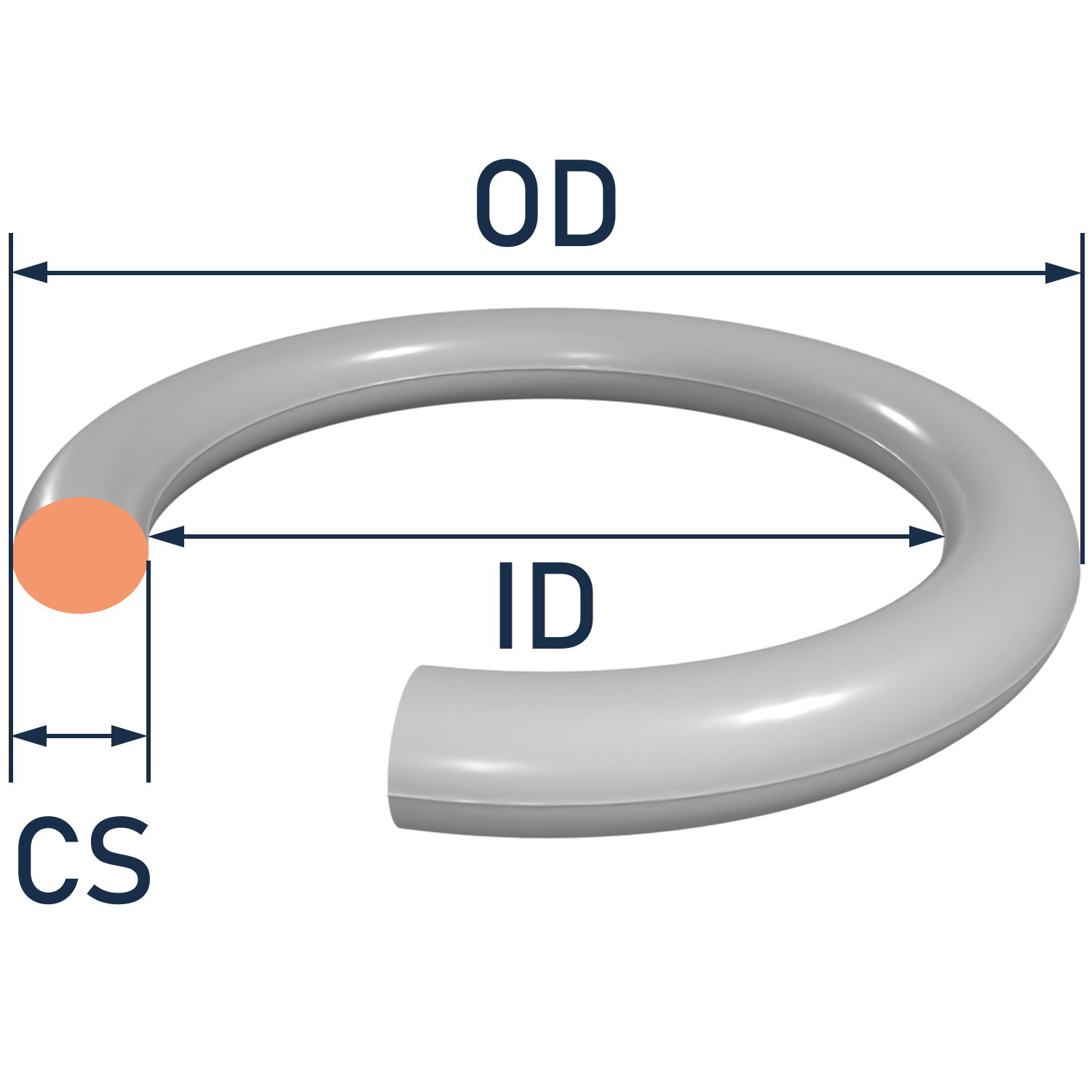
AS568 to European O-ring size cross reference chart from Canyon Components ensuring compatibility across global applications.
Back to Reference Hub

AS568 is the most widely used U.S. standard for O-ring sizes, defining specific inside diameters (ID) and cross section dimensions for elastomer sealing components. These standardized dimensions allow engineers to specify O-rings, rubber seals, and gaskets that fit reliably in standardized grooves used throughout hydraulic systems, pneumatic equipment, pumps, valves, and industrial machinery. The AS568 standard is widely used in North America and is commonly referenced for O-ring compatibility, replacement seals, and custom rubber parts.
European standards, however, often follow different sizing systems such as BS 1806, ISO metric O-ring sizes, and other regional codes used across the UK, France, Germany, and other industrial markets. While the purpose of these standards is the same, which is to define repeatable dimensions for rubber O-rings and sealing gaskets, the size numbering systems differ significantly. For example, a single AS568 dash size may correspond closely to a BS 1806 number or a European metric O-ring size, but the identification codes will not match directly.
This is why AS568 to European O-ring cross reference charts are essential for engineers and procurement teams. These cross references help translate between AS568 dash numbers, MIL-P-5516 Class B sizes, BS 1806 numbers, UK codes, and French codes, ensuring that the correct rubber O-ring or gasket can be selected even when equipment is built to international standards.
Engineers frequently encounter situations where equipment manufactured in different regions uses different O-ring size standards. A machine built in the United States may specify an AS568 dash size O-ring, while replacement parts sourced from Europe may reference BS 1806, ISO metric, or French O-ring codes. Without a cross reference guide, identifying equivalent rubber O-ring and gasket sizes can be time consuming and error prone.
An AS568 to European O-ring cross reference chart simplifies this process by listing comparable sizes across multiple standards. By comparing inside diameter, cross section, and approximate outside diameter, engineers can quickly identify compatible sealing components. This is particularly useful in industries such as aerospace, industrial manufacturing, chemical processing, food equipment, and hydraulic systems, where global supply chains require interchangeable sealing components.
Cross reference charts are also valuable for maintenance and repair operations. When replacing worn O-rings, rubber seals, or gaskets, technicians may only know the European size code or the AS568 dash number. A reliable cross reference allows them to quickly identify equivalent dimensions and source the correct replacement material, whether it is Nitrile, EPDM, FKM, Silicone, or high performance FFKM elastomers.
Several international O-ring size systems exist, each developed by different standards organizations or industries. The AS568 standard is used primarily in the United States and defines O-ring sizes using dash numbers such as -010, -214, or -325, which correspond to specific inside diameter and cross section dimensions.
European systems use different numbering conventions. For example, BS 1806 numbers originate from the British Standard system, which is widely used in the United Kingdom and other parts of Europe. UK code numbers often correspond to similar dimensional ranges but may follow slightly different numbering formats. French O-ring codes also appear in industrial equipment specifications, particularly in legacy machinery manufactured in France or other European countries.
Although these standards differ in naming conventions, the underlying goal remains the same: to standardize the dimensions of rubber O-rings, sealing rings, and gasket components used in mechanical systems. Cross reference tables help match AS568 dash sizes with BS 1806 numbers, UK codes, and French codes, enabling engineers to identify equivalent sealing components across international standards.
When referencing AS568 O-ring sizes, the defining dimensions are the inside diameter (ID) and the cross section (CS) of the rubber O-ring. These two measurements determine the standard dash number and ensure proper sealing performance when the O-ring is installed in a groove or gland.
The outside diameter (OD) can still be calculated and used as a reference dimension, but it is not the primary specification used to define an AS568 standard O-ring. Instead, the OD is derived from the inside diameter plus twice the cross section. Because of this, OD is often used only for visual comparison or rough cross referencing, rather than strict dimensional compliance.
This distinction becomes important when comparing AS568 O-ring sizes to European O-ring standards. Some European references may list outside diameter values as part of the identification process. Engineers must therefore verify that the inside diameter and cross section match the standard, ensuring that the rubber O-ring or gasket will seal correctly in the intended application.
Many global industries rely on O-ring size cross references because equipment, components, and spare parts are manufactured worldwide. Industries such as hydraulics, pneumatics, aerospace, automotive, semiconductor manufacturing, food processing, pharmaceuticals, oil and gas, and water treatment frequently encounter equipment built to different international standards.
For example, a hydraulic pump manufactured in the United States may require AS568 dash size O-rings, while replacement parts sourced from Europe may use BS 1806 or ISO metric O-ring sizes. Without a reliable cross reference, technicians may struggle to identify compatible rubber seals, elastomer gaskets, or custom O-ring replacements.
Cross reference tables allow engineers to identify compatible sizes quickly, ensuring that the correct O-ring materials, rubber compounds, and sealing geometries are selected. This helps prevent leakage, premature seal failure, and equipment downtime across critical industrial systems.
Yes. While many applications can be served using standard AS568 dash sizes or European O-ring dimensions, some equipment requires custom O-rings, specialty rubber seals, or non-standard gasket sizes. In these cases, working with an engineering team experienced in elastomer design can help ensure the correct solution is selected.
Custom O-rings can be manufactured in a wide range of elastomer materials such as Nitrile (Buna-N), EPDM, FKM (Viton), Silicone, Fluorosilicone, HNBR, and high performance FFKM compounds. These materials can be optimized for specific environments including chemical exposure, high temperatures, steam resistance, fuels, lubricants, and aggressive process fluids.
In addition to custom sizing, Canyon Components can assist with material selection, groove design guidance, chemical compatibility analysis, and international size cross referencing. Whether you require a standard AS568 O-ring, a BS 1806 replacement seal, or a completely custom rubber gasket, working with experienced engineers ensures reliable sealing performance across demanding industrial applications.